Showing posts with label Human Exploits. Show all posts

Sep 19, 2023

HiPPO Decision Making

“A/B enthusiasts...have a derisive term to describe a decision-making system that fails to put data at its heart: HiPPO — 'highest-paid person's opinion' ...

“Tech circles are rife with stories of the clueless boss who almost killed a project because of a 'mere opinion.'”

Source: “The A/B Test: Inside the Technology That's Changing the Rules of Business,” Wired, 4/25/2012

Aug 27, 2021

Exploit Explained: Left-Digit Bias

{This post is part of the Archive of Human Exploits}

“Humans are hardwired to focus on the left digit in numbers. It’s why products are priced at $3.99 instead of $4.00. But does this left-digit bias also affect medical decisions?” asked Dr. Babu Jena in a recent episode of the Freakonomics, M.D. podcast.

Dr. Jena was talking about something called left-digit bias and a study that examined the frequency of surgeries performed on heart-attack patients who were admitted to hospital two weeks before their 80th birthday (while they were still 79) compared to patients who were admitted two weeks after their 80th birthday. Per Forbes, the study found that:

“[P]atients who just turned 80 were 24% less likely to receive cardiac bypass surgery compared to medically similar 79-year old patients who were two weeks shy of their 80th birthday. The 80-year old patients also experienced higher death rates compared to the 79-year old patients, after 30 days of hospitalization.

“Furthermore, these discrepancies were not seen when comparing patients two weeks before and after their 77th, 78th, 79th, 81st, 82nd, or 83rd birthdates. Only the transition from age 79 to age 80 resulted in a statistically significant change in treatment.”

This human exploit has long been known to practitioners is my industry (As Seen on TV), the offer shown at the top of this post being so common it isn't even given much thought anymore. That is, no ASOTV marketer would ever market a product for $15 or $20. It's always $14.99 and $19.99. (On a side note, some still use $14.95 and $19.95 despite the fact this gives away four cents for no good reason. There is no corresponding right-digit bias!) 

We use this little trick because we have long known that prices ending in 99 somehow feel like one dollar cheaper instead of just one penny cheaper. Now, apparently, there's an official name for it.

Nov 29, 2020

When You Negate the Frame, You Strengthen It

“When you negate the frame, you evoke the frame. When you evoke the frame, you strengthen it.”

- George Lakoff

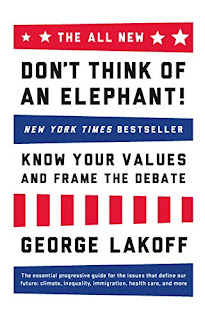
The title of Lakoff’s book (above) is a perfect example of why this is true. The more you tell people not to think of an elephant, the more they will struggle to keep that image out of their minds.

Lakoff's book is mostly a pro-Democrat political screed. (The original sub-subtitle is "The Essential Guide for Progressives.") The trouble is he chose the worst possible audience to give this advice: pundits, activists, and politicians.

All it took was the presidency of one Donald J. Trump to demonstrate this was a fool's errand. Clearly consumed by TDS, Lakoff spent most of the Trump years repeating the quote above like a mantra, all but begging people on his side (especially journalists) to stop negating — and thereby evoking and strengthening — DJT's powerful frames.

Of course, nobody listened.

Oct 30, 2020

Exploit Explained: Preference Falsification

{This post is part of the Archive of Human Exploits}

"Preference falsification is misrepresenting one’s views or desires because of perceived social pressures. Conforming to prevailing public preferences yields security, acceptance, and respect.

"Consider the Soviet Union. Single party rule was maintained by a culture of mendacity. Only a minority believed that Lenin and his successors were good rulers, but everyone pretended to think so. Speaking one’s perceived truth was too dangerous ...

"According to a Cato Institute poll, 62 percent of Americans say that the current political climate prevents them from expressing their views. Majorities of Democrats (52 percent), independents (59 percent) and Republicans (77 percent) now self-censor. The only group where the majority did not feel pressured into silence were leftist Democrats.

"Another study found that the higher the level of education, the greater the self-censorship."

- "How Availability Cascades are Shaping our Politics"

Oct 2, 2020

Exploit Explained: MySide Bias

{This post is part of the Archive of Human Exploits}


"[M]any commentators have ascribed some part of the [political] divide to what they term our 'post-truth' society, but this is not an apt description of the particular defect that has played a central role in our divided society. The cause of our division is not that people deny the existence of truth. It is that people are selective in displaying their post-truth tendencies.

"What our society is really suffering from is myside bias: People evaluate evidence, generate evidence, and test hypotheses in a manner biased toward their own prior beliefs, opinions, and attitudes ...

"It turns out that myside bias is not predictable from standard measures of cognitive and behavioral functioning. The degree of myside bias that people show is not correlated with their intelligence or level of actively open-minded thinking; nor is it correlated with their educational level. It is not correlated with how much they display other biases...myside bias in one domain is not a predictor of the myside bias shown in another domain. It is simply one of the most unpredictable of the biases ...

"In short, just as we are gorging on fat-laden food that is not good for us because our bodies were built by genes with a selfish replicator survival logic, so we are gorging on memes that fit our resident beliefs because cultural replicators have a similar survival logic. And just as our overconsumption of fat-laden fast foods has led to an obesity epidemic, so our overconsumption of congenial memes has made us memetically obese as well. One set of replicators has led us to a medical crisis. The other set has led us to a crisis of the public communication commons whereby we cannot converge on the truth because we have too many convictions that drive myside bias."

- Prof. Keith E. Stanovich, "The Bias that Divides Us"

Apr 21, 2020

Exploit Explained: Dunning-Kruger Effect


{This post is part of the Archive of Human Exploits}

I first learned of this bias from Y Combinator's Paul Graham, likely from his essay, "How to Get Startup Ideas," in which he writes:
When searching for ideas, look in areas where you have some expertise. If you're a database expert, don't build a chat app for teenagers (unless you're also a teenager). Maybe it's a good idea, but you can't trust your judgment about that, so ignore it. There have to be other ideas that involve databases, and whose quality you can judge. Do you find it hard to come up with good ideas involving databases? That's because your expertise raises your standards. Your ideas about chat apps are just as bad, but you're giving yourself a Dunning-Kruger pass in that domain.
Once I knew what it meant, that phrase "Dunning-Kruger pass" stuck with me — although I tended to misremember it as Dunning-Kruger bridge. (More on this in a minute.)

Graham also mentions the bias in "How to Convince Investors":
To evaluate whether your startup is worth investing in, you have to be a domain expert. If you're not a domain expert, you can be as convinced as you like about your idea, and it will seem to investors no more than an instance of the Dunning-Kruger effect. Which in fact it will usually be. And investors can tell fairly quickly whether you're a domain expert by how well you answer their questions. Know everything about your market.
Here's a succinct explanation of the effect from The Decision Lab:
The Dunning-Kruger effect is a cognitive bias in which individuals are prone to assess their cognitive ability as greater than it truly is. Most simply, individuals who are the least competent at a task often incorrectly rate themselves as high-performing even when they lack particular knowledge or expertise.

The Dunning-Kruger effect is related to the cognitive bias of illusory superiority and comes from the inability of people to recognize their lack of knowledge or ability. In turn, these individuals will lack the ability to recognize their own mistakes and errors, making them exceptionally confident and biased self-evaluators. They are also unable to fairly judge other people’s performance.

This bias was first described by social psychologists David Dunning and Justin Kruger in 1999. Dunning and Kruger found the bias by testing students in the areas of humor, grammar, and logic. They compared each individual student’s test results with the same student’s estimate of how well they scored. The results were that those who scored the lowest vastly overestimated their scores, while those who did best slightly underestimated their performance. It is illustrated in the graph below which shows those who have almost zero knowledge on a topic display low confidence, but those with a minimum level of competence vastly overestimate their abilities. As the level of knowledge increases, those who are more competent are more aware of the gaps in their knowledge and display lower confidence. On the far end of the spectrum are experts in a particular field who display a high degree of confidence.
(Warning: The science part of the above finding is shaky. "Dunning-Kruger effects reported in the literature are mostly the result of statistical artefacts," argues social psychologist Lee Jussim.)

My sense of this bias is as follows. Have you ever been offended when someone argues with you about your area of expertise even though they really don't know the first thing about it? You want to scream at them: "You couldn't [do even a simple version of this thing] if your life depended on it!" And yet they have the confidence to tell you what you should be doing, as if it's easy. They might even have the temerity to argue with you about it! How?! Well, that's Dunning-Kruger effect in action.

The interesting thing about it is the conditions necessary. In my experience, the effect is most common in people who have an unquestionable area of expertise themselves. It's just not your area, and it may not even be close. I've debated advertising techniques with a top-tier personal trainer, and what it takes to write well with several first-rate entrepreneur bosses. The trainer didn't know the first thing about advertising, and I've never had a boss who knew how to write well. So how do they get from warranted confidence to unwarranted confidence? From acceptable superiority to illusory superiority?

This may be where the idea of a Dunning-Kruger "bridge" stuck in my mind because I visualize it as building a bridge between concepts (or "domains," as Graham put it). We mistakenly assume that because the bridge starts with one end on solid ground, it ends with the other end on solid ground.

It doesn't, which is why it crumbles.

Related: An Ignorant Mind is Filled with Clutter

Aug 20, 2018

Exploit Explained: Selection Bias


{This post is part of the Archive of Human Exploits}

With the possible exception of confirmation bias, selection bias is the most important flaw in human reasoning I have encountered to date. Simply defined, it is the human tendency to think we are observing, gathering or choosing things at random when, in fact, our biases are guiding the process.

Specific forms of selection bias include publication bias or reporting bias, which Wikipedia defines as "the distortion produced in community perception or meta-analyses by not publishing uninteresting (usually negative) results, or results which go against the experimenter's prejudices, a sponsor's interests, or community expectations."

Those words "uninteresting" and "negative" are key to understanding this foible. We are pre-programmed (and often pre-suaded) to pay attention to certain things and ignore others. Yet for some reason, we insist on pretending we are not. Whether it's a desire to appear unbiased or an ego-driven overestimation of our cognitive abilities, we just don't like to admit when we are selecting things for irrational reasons.

A great example is the dozens of articles I read every month. Even though I find them in all kinds of random places, they all end up reinforcing my core beliefs and interests. Am I that brilliant? Or is this some strange coincidence? Maybe God is trying to tell me something?

Nope. It's selection bias. Although my sources are diverse and may appear random, they are my sources because I found them interesting at some point. Why did I find them interesting? In most cases, I selected them because they reinforced my core beliefs and interests. It's a tautology.

Along similar lines, if and when I have a negative reaction to the content from a source, I will mute/unfollow/unsubscribe. In other words, I will engage in de-selection bias.

The reason I think this bias is one of the most important is because it's behind much of the extreme partisanship we are currently experiencing in America. Specifically, the politics of today have driven people to insane levels of selection bias where they only engage with highly partisan sources of information that reinforce their worldview  all while loudly insisting those sources are just sharing the objective truth.

Exploit Explained: Survivorship Bias


{This post is part of the Archive of Human Exploits}

According to Cicero, Diogenes was once asked about paintings of people who had survived shipwrecks. "You who think the gods have no care of human things: What do you say to so many persons preserved from death by their especial favor?"

Diogenes replied: "I say that their pictures are not here who were cast away, who are by much the greater number."

What Diogenes identified is something known as survivorship bias. According to Wikipedia:
"Survivorship bias (or survival bias) is the logical error of concentrating on the people or things that made it past some selection process and overlooking those that did not, typically because of their lack of visibility. This can lead to false conclusions in several different ways. It is a form of selection bias.
"Survivorship bias can lead to overly optimistic beliefs because failures are ignored, such as when companies that no longer exist are excluded from analyses of financial performance. It can also lead to the false belief that the successes in a group have some special property, rather than just coincidence (correlation proves causality)."
A famous example of this bias is the story of World War II statistician Abraham Wald. According to TruthHawk.com:

"Wald was a Hungarian mathematician who emigrated to the United States. During World War II, he was part of the military’s Statistical Research Group.
The military had a project to learn how to best protect their planes from enemy gunfire. They would look at planes returning from war, and see which areas had the most bullet holes. Clearly, these areas were in need of protection – so the recommendation was to enforce those areas of the planes with armor for future missions.
"Wald saw the flaw in this analysis, and produced an elegant fix. He reasoned: if a plane is returning from combat, it means that it was not shot down by the enemy. So the areas riddled with bullet holes were least in need of protection, because the planes could survive a strike on those points.

Instead, Wald concluded: reinforce the areas where returning planes had suffered no damage. Those were most likely to be mission-critical, because no returning plane had bullet holes in those sections."

This bias is related to the concept of insensitivity to base rates. Usually, that's considered in the negative case. A plane crash affects our perception of flying even though thousands of planes land safely. This bias is something like the inverse: If planes routinely crashed, we wouldn't want to fly in one just because a few had landed safely.

Survivorship bias pops up often in my everyday life. In business, I often hear pitches for products that reference one or two similar items that are well-known successes. My job is often to remind people of all the similar items that are lesser-known failures.

Then there's diet advice. My friends and family are constantly experimenting with some new diet plan or another. Their reasons for trying the diet are always the same: They read or heard that someone lost an amazing amount of weight on the plan. Of course, no one ever catalogs or reports how many other people didn't lose weight, suffered side effects or gained all the weight back later.

Jun 19, 2018

Tells for Cognitive Dissonance

Cognitive dissonance (CD) is "the mental discomfort (psychological stress) experienced by a person who simultaneously holds two or more contradictory beliefs, ideas, or values." Cartoonist turned political commentator Scott Adams has taken our understanding of this phenomenon further by identifying certain "tells" (i.e. signs) for when a person is in CD. The point is that when a person is experiencing this form of mind strain, he or she will use predictably irrational methods to relieve it.

The following is my curated list of CD tells. Several originate with Adams, who published his own list in 2015. Many have to do with President Donald Trump as his election and presidency have been a huge CD trigger for many.

LIST OF TELLS
{Check back for updates}

The Absurd Absolute (Adams). A type of "straw man" attack, this counter takes your argument and restates it as an absolute, often using words such as "always" or "never," so that it is easier to argue against. Per Adams, this tell often includes sarcasm and starts with the word "so." Example: You make an argument in favor of one of President Trump's decisions. They respond, "So what you're saying is Trump is always right."

The Ad Hominem. This one is actually a logical fallacy, but it is also sure-fire sign of CD. You articulate a rational point, and they respond by attacking you or the person you are defending. Example: You cite President Trump's three greatest, measurable achievements. They respond, "He has also achieved being the most racist a-hole ever to occupy the White House."

Juvenile Reversion. When kids and teens are losing an argument, they fight back with name-calling, curse words and low-brow humor. When adults experience CD, they sometimes revert to this behavior. Example: In response to President Trump's historic summit with Kim Jung Un in Singapore, a friend and ardent Trump hater sent me a doctored video of Kim touching Trump's back to stick a crude drawing of a penis to his suit jacket.

The Laundry List (Adams). In the consumer-products world, we are often presented with what I call "Swiss Army products." These are products that do more than two or three things. No one thing is strong enough to interest consumers, but the belief is that the sum of the parts will yield a successful whole. A similar type of thinking is behind this tell. Because no one point is strong enough to counter the argument presented, the person strings together more than two or three things in the hopes it will yield a convincing whole.

Too Many Explanations (Adams). When people offer multiple, divergent theories to explain away something that challenges their worldview, they are likely experiencing CD. It's an attempt to use quantity (many possible answers) to relieve the mental stress of a lack of quality (none of them good). Example: CNN once put together 24 different theories (what Adams called a "cognitive dissonance cluster bomb") to explain how Donald Trump could possibly defeat Hillary Clinton to become president.

Word Salad (Adams). A jumble of partial thoughts that is hard to follow or understand. The person is usually trying to fit multiple, emotional points into a single paragraph, but CD has short-circuited their capacity for coherence.

The Zero-Calorie Reply. When people realize they have to concede your point, this can often trigger CD. They know they are smarter than you, yet somehow you have outmaneuvered them! To save their ego, they conclude that they must just be exasperated with you. The tell for this is a response completely lacking in any substance. It often involves emojis or other cutesy Internet shorthand. Example: "OK, Jordan. LOL."

RELATED POSTS

Jun 12, 2018

Exploit Explained: Anchoring


{This post is part of the Archive of Human Exploits}

One of the most powerful tools in a negotiation is setting an anchor. One of the top things to look out for in a negotiation is someone else trying to set an anchor. As the name suggests, it can be extremely difficult to resist the holding power of this cognitive bias.

Writing in the Journal of Economic Psychology, three researchers from the UK Centre for Behavioural and Experimental Social Science explain:
"During decision making, anchoring occurs when individuals use an initial piece of information to make subsequent judgments. Once an anchor is set, other judgements are made by adjusting away from that anchor, and there is a bias toward interpreting other information around the anchor. 
"For example, the initial price offered for a used car sets the standard for the rest of the negotiations, so that prices lower than the initial price seem more reasonable even if they are still higher than what the car is really worth. 
"Studies have shown that anchoring is very difficult to avoid. For example, in one study students were given anchors that were obviously wrong. They were asked whether Mahatma Gandhi died before or after age 9, or before or after age 140. Clearly neither of these anchors are correct, but the two groups still guessed significantly differently (choosing an average age of 50 vs. an average age of 67)."
There are many techniques for countering the effects of this human exploit. When negotiating dollar amounts some say you should always go first to be sure you set the anchor and set it high. Others counsel the opposite:
"The fact is high anchors make deals go away. They kill deals you otherwise should have made ... 
"Many companies or people will try to get a price out of you early when they are shopping. Most likely, if they are pushing you for a quick price up front, you are in fact the fool in the game. They only want to use your number to drive down the price with the company they are going with anyway – the favorite.  So don’t do it ...
"The seasoned players want to get as much information out of you as possible before they set their ranges. They figure whatever number you throw, it’s only an opening offer and they’ll move you off of it anyway. They see your number as more information, and they crave information."
The above advice comes from The Black Swan Group, a consultancy founded by the guy who wrote the best book on negotiation I've ever read. I believe it's spot on.

In my experience, people try to set anchors all the time, whether consciously or unconsciously. My defense is to do my homework and ignore their anchors. Knowing the fair price going in is the best way to avoid drifting toward someone else's price.

Recently, when someone tries to set an extreme anchor, I have also been countering with an opposite extreme. That technique hasn't always resulted in the desired outcome (e.g. my desired price), but it does immediately clear out the BS so we can get down to getting serious. My philosophy is that if I'm not going to get to a reasonable place, I'd rather find that out quickly. Extreme counter-anchors tend to have that effect. Besides, if the person is haggling, you immediately draw them toward your anchor and away from their own.

Apr 24, 2018

What I Learned at Cialdini's Persuasion Workshop


I’ve been a fan of Dr. Robert Cialdini’s work for some time having read his seminal book, Influence: The Psychology of Persuasion (now autographed by the man himself!) and his new sequel, Pre-Suasion: A Revolutionary Way to Influence and Persuade (also autographed!).

Now that I have become a 'man of means,' I've started indulging my desire to meet my intellectual heroes and learn from them in person if possible. In researching Cialdini with this in mind, I discovered and recently attended his Principles of Persuasion (POP) workshop in Tempe, Arizona.

The workshop was primarily led by Dr. Gregory Neidert who picked up the mantle and taught the persuasion science course at Arizona State University when Dr. Cialdini retired from teaching. He, too, is now retired and has moved on to consulting and running workshops for Cialdini’s firm. The POP workshop was two intensive days focused on exploring the six principles of persuasion from Influence. Dr. Cialdini gave an opening lecture the first day and then gave a talk about his new seventh principle (Unity aka the power of “we”) during lunch. He also graciously met us for a Q&A cocktail hour after the first day was complete, which is when he signed my books and posed with me for the picture above.

Everyone had questions, of course, mostly about their personal problems. I used my opportunity to see if I could resolve a Twitter mystery. Cartoonist and political commentator Scott Adams has been promoting the idea that Cialdini consulted for Hillary Clinton’s campaign and that this is the moment her persuasion game went from non-existent to equal-to-Trump during the campaign. He refers to Cialdini as the “Godzilla of persuasion,” or just “Godzilla.”

I wondered if Dr. Cialdini would confirm or deny?
Me: “I have one, off-the-record question for you, sir. Are you, in fact, Godzilla?”
Cialdini: (grinning widely) “I’m not sure if I should be flattered or offended by that nickname. Do I destroy cities?”
Me: “Well, I don’t think they mean you have it in for Japanese people or anything.”
He then turned to address another question. Oh well.

Although I didn't learn whether Cialdini is Godzilla,*  I did learn quite a bit from his workshop. Below are a few things that stuck with me.

1. Contrast is the ultimate persuasion amplifier. As mentioned, Dr. Cialdini has seven principles of persuasion in total. Contrast isn't one of them. That's because it is what he calls an "amplifier," something that super-charges a persuasion technique. Dr. Niedert went further, calling contrast "the dark matter that holds influence together." In all of our exercises using all of the principles, we learned to use contrast to improve our persuasive punch. The best example of this involves the legendary advertising executive Rosser Reeves.

Reeves was a Madison Avenue man during the 50s and 60s, the time period portrayed in the AMC hit show, Mad Men. In fact, he was used as "one model for the professional accomplishments of the series' protagonist, Donald Draper (played by Jon Hamm)," according to Wikipedia. When I first got into the infomercial business, I was obsessed with these Old Masters of advertising (as I call them). I paid about $80 to acquire Reeves' book, Reality In Advertising, when it was out of print. It was worth the price. I picked up several great insights from Reeves, including the timeless concept of the "unique selling proposition" (USP), a term he coined.

At the POP workshop, I heard the following apocryphal story about Reeves:
One beautiful spring afternoon, Rosser Reeves and a colleague were walking through Central Park to their office on Madison Avenue. They saw a man sitting in the park begging for money. He had a tin cup for donations with a handwritten cardboard sign that read: "I am blind." 
The man's cup contained very few coins. Reeves thought he knew why and told his colleague that he could dramatically increase the amount of money in the cup simply by adding four words to the sign. Naturally, his colleague was skeptical. 
Reeves went to the blind man and offered to help fix his sign. The man agreed. Reeves took a marker from his pocket, added four words to the sign and then retreated with his colleague to see what would happen. 
Within minutes, people were dropping one coin after another into the man’s cup.
What were the four words Reeves added to the sign? "It is spring and ..." 


After telling this story, Dr. Niedert explained that contrast is always available to us. It's just that sometimes it takes a skilled persuader to see it and call people's attention to it. The people in Central Park that day saw and enjoyed a beautiful spring day. They saw and ignored a blind man begging for change. Simply by connecting the two things and creating contrast, Reeves persuaded them to change their behavior.

2. There is a moment of power after no. I've been in a lot of hard negotiations with the toughest negotiators imaginable. (I live and work in New York, after all.) Yet I never saw this before Cialdini's workshop. It's absolutely true. Dr. Neidert counseled us to resist the normal human response to rejection; i.e., shrinking back. "If you retreat from the moment, you lose," he said. "If you retreat in the moment, you win." What he meant is that a skilled persuader always has a fallback position, a prepared 'ask' that also represents a desirable outcome. More important, that second request is much more likely to be granted because of the principle of reciprocity. This is the "moment of power." The person who told you "no" feels you've given them something and that they owe you something.

Of course, this can be used in a manipulative way where your "fallback" position was your actual position all along. Dr. Niedert was careful to add he was talking about a position that was "not intended" to be the real position all along. He also explained at length how ruses by unethical persuaders can easily backfire, destroying the credibility and trust that is required for any successful negotiation.

I agree with him in principle, but I have met some people that are immune to feelings of reciprocity. They will gladly take whatever you give them and feel no obligation to give back. In these negotiations, I have found it's smarter to go in with a meaningless concession at the ready. To be more precise: The concession is meant to be meaningful in some way to them but not very meaningful to us. We then explicitly leverage that concession to get what we ultimately want. Not particularly ethical, I know. But it's very effective when dealing with negotiators who lack any type of empathy.

3. A limited-number offer is more persuasive than a limited-time offer. This was of particular interest to me because the limited-time offer is much more common in my business (infomercials). The classic example is a clock ticking down from 10 minutes, which is supposed to be how much time the viewer has left to order. I can only think of one type of offer that mentions a specific, limited number of units as a tactic: offers for collectible coins. They'll say something like, "only 500 of these coins were ever minted." Every other time, we usually say something cliché and vague like, "supplies are limited." Thanks to Cialdini's workshop, I'll be pondering how to fix this in future direct-response commercials.

These are just three of the many fascinating and useful things I learned during my two-day immersion course in Godzilla-level persuasion. I'll be sure to post more about it here and on Twitter.

RELATED POSTS

* Scott Adams says Dr. Cialdini has confirmed he consulted for HRC's campaign. He may be referring to this article from the Financial Times where the author got a somewhat firmer answer than I did.

Mar 4, 2018

The Archive of Human Exploits

Svengali
Welcome to my "Archive of Human Exploits." I have always been fascinated with the 'dark arts' of psychology and defense against those dark arts. That interest intensified around the time I joined the infomercial industry, where practitioners are accused of employing hypnotic powers of persuasion. As infomercial producer John Miller once put it to me: "They claim we have Svengali-like powers." Rather than finding that idea disturbing, I found it fascinating.

The thinkers who have the most to do with my fascination are the Old Masters of advertising (Claude Hopkins, Albert Lasker, David Ogilvy, Rosser ReevesJohn Caples, Joseph Sugarman), Dr. Robert Cialdini, Nobel Laureates Daniel Kahneman and Richard Thaler, and cartoonist turned political commentator Scott Adams.

This archive will be my way of keeping track of what I have learned and what I continue to learn. Check back often for new exploits and articles.

EXPLOITS (click to read)

Feb 22, 2018

Exploit Explained: The Endowment Effect

{This post is part of the Archive of Human Exploits}

Two founders of behavioral economics, Nobel Laureates Daniel Kahneman and Richard Thaler, coined the term endowment effect to explain why we tend to value things more if we own them.

Wikipedia neatly summarize their research backing up the claim as well as some other studies that have done the same:
[P]articipants were given a mug and then offered the chance to sell it or trade it for an equally valued alternative (pens). They found that the amount participants required as compensation for the mug once their ownership of the mug had been established ("willingness to accept") was approximately twice as high as the amount they were willing to pay to acquire the mug ("willingness to pay"). 
Other examples of the endowment effect include work by Ziv Carmon and Dan Ariely, who found that participants' hypothetical selling price (willingness to accept or WTA) for NCAA final four tournament tickets were 14 times higher than their hypothetical buying price (willingness to pay or WTP).  
Also, work by Hossain and List, discussed in The Economist in 2010, showed that workers worked harder to maintain ownership of a provisional awarded bonus than they did for a bonus framed as a potential yet-to-be-awarded gain. In addition to these examples, the endowment effect has been observed using different goods in a wide range of different populations, including children, great apes, and new world monkeys.
While we should always be cautious of things "proved" with artificial lab experiments, experience supports the existence of this effect. For example, imagine haggling at a garage sale. If you're the seller, the stuff on the table is yours, so your perceived value for these items will be relatively high. If you're the buyer, the stuff on the table is someone else's, which clearly changes its perceived value.

This reminded me of a routine by the late, great George Carlin (here and below) that could be dubbed "the endowment effect bit." Warning: It's Carlin, so the language is not safe for work (NSFW) or family friendly.


Feb 21, 2018

The 7 Deadly Sins are 7 Keys to Persuasion

{This post is part of the Archive of Human Exploits}


Another way to describe human exploits is human weaknesses. Of these, vices are the most fundamental. Ancient Christian thinkers articulated seven major vices, the so-called "seven deadly sins." According to Thomas Aquinas's Summa Theologica, they are:
  1. Pride
  2. Greed
  3. Lust
  4. Envy
  5. Gluttony
  6. Wrath
  7. Sloth
It's unnecessary to discuss how trained persuaders use greed/envy to entice and lust (sex) to sell. However, the other vices are non-obvious from a persuasion perspective and warrant further consideration.

Pride. Flattery will get you everywhere. Flattery engenders "liking," the fifth of Dr. Cialdini's seven principles of persuasion. (It seems these things come in sets of seven.) Another aspect of pride involves the sense of ownership we have for our own ideas or possessions. A whole host of exploits derive from this, including confirmation bias (inability to recognize information that contradicts our beliefs), the endowment effect (overvaluing things merely because we own them) and so on.

Gluttony. 24-hour buffets. Endless shrimp. Bottomless bowls of pasta. Everyone is perpetually on a diet, and few believe overeating is acceptable, yet these gimmicks continue to win business in the restaurant industry. Ancient thinkers were less interested in what such behavior says about a person's stomach than what it says about his mind; i.e. his judgment. What might someone who is so focused on the basest of human needs be willing to give up to satisfy that need? The classic example is the biblical story of Jacob and Esau. Jacob, whose name means a pejorative for persuader (deceiver), convinced his famished brother Esau to give him his birthright in exchange for some bread and lentil stew. As far as we know, he didn't even have to offer Esau a "bottomless" bowl of said stew to do it.

Wrath. Selling to an angry customer. Negotiating with a furious partner. It may seem odd to think of fighting as persuasion, but consider this: A boxer or MMA striker can spend a considerable amount of time trying to convince his opponent to drop his guard or make some other ill-advised move, exposing him to attack. He feints and sets traps. Indeed, one of the more effective traps is intentionally angering his opponent, throwing him off mental balance and instigating errors. (This is same strategy behind "trash talking" in football, basketball and so on.) Re-framed this way, it's possible to see other ways a trained persuader might exploit this vice for gain. Anger is ultimately a weakness and no one operating out of weakness can withstand the steady strength of a calm opponent. Anger also leads to remorse and exhaustion, two emotional states that cause people to overcompensate in the opposite direction. Persuaders resilient enough to weather the storm will often find it easy to get their way when wrath has blown itself out.

Sloth. We tend to think of persuasion as getting someone to take an action, but getting people to choose inaction can be just as effective. This is strategy behind: a) negative-option selling, where a customer has to "opt out" to avoid getting charged for something; b) continuity schemes, where a customer has to cancel to avoid a monthly charge; and c) the default effect. This list is by no means comprehensive, either. People will also take action now to avoid having to take more action later. That idea is behind everything from selling washing machines to insurance plans, explains the success of mini-grocery stores in drugstores and much more. In other words, "convenience" is just another way of saying "slothful behavior."


Feb 20, 2018

Exploit Explained: The Default Effect

{This post is part of the Archive of Human Exploits}


If you've seen something like the above, you have a clue as to the huge importance of the default effect. Simply put, most people are lazy (sloth, the seventh deadly sin) and will choose inaction over action in most situations.  Trained persuaders know all about this human exploit, so they work hard to ensure they are the 'inaction option' where such a thing is possible. That's how you get appeals like the one above.

The default effect is so powerful that it's the driving force behind applications of behavioral economics in public policy. Nobel Laureate Richard Thaler and Harvard Professor Cass Sunstein coined the term "nudge," a persuasion method that gently pushes people toward what are deemed good choices primarily using default effects. "Human beings often suffer from inertia," Professor Sunstein writes in a 2017 article for Bloomberg. "Even if it is easy to go, or to change the default, they just don’t move. We take the path of least resistance."

As a case in point, Professor Sunstein describes a recent legal case (he's a law professor):
The sad tale began in 2000, when a telemarketing firm, Suntasia Marketing, persuaded hundreds of thousands of consumers to pay a monthly fee for subscriptions that were essentially worthless. Telemarketers called people out of the blue and said (falsely) that they represented the consumer’s bank. They reported good news, to the effect that the consumer had won a reward, consisting of (for example) a subscription to a “buyer’s club,” which would offer consumer gasoline and airline rebates. On average, consumers paid Suntasia $239 over the course of their subscriptions, and received nothing in return. 
In 2007, the Federal Trade Commission sued Suntasia. In response, the court directed the company to notify its subscribers of their right to cancel. According to the court’s order, subscribers who had been enrolled for six months or less would receive a letter saying that they would be canceled by default -- but adding that they could continue if they wished (by letter or phone call). Those who had been enrolled for more than six months would receive a letter saying that their subscriptions would continue by default -- but adding that they could cancel if they wished (also by letter or phone).
Did the default rule matter? Absolutely.
When subscriptions were canceled by default, almost everyone ended up canceling -- a stunning 99.8 percent. But when people were merely notified of their right to cancel, most people ignored the letter and so continued to subscribe (about 63.2 percent).
What's ironic is that in attempting to punish of the most heinous scams in the telemarketing business, the FTC permitted Suntasia to use another telemarketing scam it had explicitly banned: negative options. According to the FTC, this term encompasses a broad category of "commercial transactions in which sellers interpret a customer’s failure to take an affirmative action, either to reject an offer or cancel an agreement, as assent to be charged for goods or services." Yet that is exactly the method the FTC directed Suntasia to use to determine if its longer-term customers should keep getting charged.

The default effect is both powerful and non-obvious. Trained persuaders take note. Buyers beware. Here's a little extra motivation for the latter (because, inertia) ...

In his book Originals: How Non-Conformists Move the World, Adam Grant claims that one of the most telling tests of whether someone is an original thinker is if he or she changes the default Web browser. In a study of customer-service agents he references in the book, it was shown original thinkers favored Web browsers that (at the time) required action to use. That is, they were more likely to use installation-required browsers such as Firefox or Chrome over default browsers  such as Internet Explorer (PC) and Safari (Mac).

One could extend this hypothesis to email clients as well. If you're still using an AOL address, for example, you're probably not an original thinker. However, this also implies a solution. If you want to be more original, or maybe just perceived as such, you can install and use a non-default browser like Google Chrome, which is my preference. (See what I did there?)

Oh, and pro tip: Always click "no" when messages like the one at the top of this post pop up.

Feb 7, 2018

Now That's a Barnum Move!

{This post is part of the Archive of Human Exploits}


The release of Hugh Jackman's new movie, The Greatest Showman, got me interested in the persuasion tactics of P.T. Barnum. As a result, I decided to read Joe Vitale's There's a Customer Born Every Minute.

In the book, Vitale argues that Barnum was "much more than a showman ... he was a dedicated businessman and entrepreneur with a razor-sharp mind." Barnum's No. 1 business talent was dreaming up publicity stunts the press couldn't help but cover, earning him tons of free 'advertising.' According to Vitale:
At one point he had an elephant plowing the field of his property. Why? Because the field was near the railroad tracks that took passengers into New York City .... 
'Newspaper reporters came from far and near, and wrote glowing accounts of the elephantine performances,' Barnum wrote. 'The six acres were plowed over at least sixty times before I thought the advertisement sufficiently circulated.'
Barnum's greatest hits included touring with an elderly blind slave who claimed to be George Washington's former nurse (which would have made her 161 years old), appearing before Queen Victoria with his famous child dwarf known as "General Tom Thumb" and exhibiting the "FeeJee Mermaid," which was actually the upper half of a monkey sewn on to the bottom half of a fish. Of course, he also created and popularized the circus that still bears his name, a process that involved launching the first national celebrity elephant, a 6-ton behemoth named "Jumbo."

The point of Vitale's book is that modern persuaders need to think more like Barnum and create visual spectacles that can't be ignored. As I was reading that advice, Elon Musk announced he was selling a $500 flamethrower (shown above) branded with the name of his new tunnel-drilling startup, The Boring Company. Four days later, he had sold out of all 20,000 of them.

The point of the stunt was to raise $10 million for his startup, according to multiple news sources. Not only did Musk achieve his goal, he received a ton of social media buzz and media coverage, including a priceless negative reaction from government regulators who it was reported were not amused.

I thought: Now that's a Barnum move!

Not long thereafter, Musk tweeted the photo below and announced he was launching a Tesla Roadster into space in the nose of a SpaceX Falcon Heavy rocket. (For those keeping score at home, that's a double brand hit as he owns both Tesla and SpaceX.) The point of the stunt was to demonstrate a private company can now do a job only NASA used to be able to do: put vehicles into space.


Since then, Musk has been providing updates on the journey of the car and its mannequin driver, which he dubbed "Starman" after the David Bowie song. As you might expect, he's been getting a ton of national press coverage and social media buzz.

Now that's a Barnum move!

If Musk keeps this up, he may just out-do Barnum himself. In the meantime, professional persuaders ought to be paying close attention.

Jan 29, 2018

Clickbait: Dissecting the Need to 'Stay Informed'

{This post is part of the Archive of Human Exploits}


Much has been written about how the Internet hijacks our brains. Exhibit A is the phenomenon known as "clickbait," which Wikipedia defines as "web content whose main goal is to get users to click on a link to go to a certain webpage." In most cases, the content is positioned as some form of "news."

There are several human exploits working together to empower clickbait news, all of which fall under a rationalization often described as the need to "stay informed." In a recent article titled "Why You Should Stop Reading News," Shane Parrish of Farnam Street explains the pull of that need and why it's a trap:
I've stopped consuming news. At first, it was really difficult. When my friends would start talking about something topical and emotionally charged and ask me what I thought, I'd have to say I don't know. This was followed by a 'What!?' and 'You have to read this' as they took out their phones to text me a link to an article I would never read. One hilarious aspect of this situation is that they often expected me to stop the conversation with them and read the article so I could share in their outrage. No thanks. 
Being well informed isn't regurgitating the opinion of some twenty-two-year-old with no life experience telling me what to think or how outraged to be. Your first thought on something is usually not yours but someone else's. When all you do is consume, you are not only letting someone else hijack and direct your attention; you are also letting them think for you.
Parrish alludes to several of the exploits that make clickbait so effective. I see at least four ...

1. Attention. "Getting attention is step one in any persuasion play," says Scott Adams, a trained hypnotist who gained celebrity as a cartoonist and is now a popular political commentator. Clickbait headlines are cleverly designed to get the most attention in a medium (the Internet) that is already optimized for grabbing attention, which is what makes them so irresistible (and insidious). One of the most powerful phrases employed is also one of the simplest: "BREAKING NEWS!" Another must-click phrase I am seeing a lot is "bombshell report" and its variants. Attention is an exploit because the things to which we pay attention naturally rise in importance in our mind — even if they are actually just as important (or less important) than things we are ignoring.

2. Curiosity. As Wikipedia explains in its entry, clickbait headlines "typically aim to exploit the 'curiosity gap,' providing just enough information to make readers curious, but not enough to satisfy their curiosity without clicking through to the linked content." This is actually an old technique. I've ready many books by the 'old masters' of advertising going back a century or more. They all agree that curiosity headlines are some of the most effective.

3. Variety. Life coach Tony Robbins considers variety one of our six core human needs. "Variety creates excitement for us," he writes. "It makes us feel alive. And we need surprises in our life, because that’s what helps us grow." By definition, news is novel and novelty equals variety. As Parrish explains, though, clickbait perverts the true purpose of variety. Instead of helping us grow, it helps the content provider's audience numbers and profits grow.

4. Outrage. Trained persuaders know that emotion underlies every human decision. For example, experts in selling have long known that people buy on emotion and justify their purchases later. That is, causing someone to strongly desire a product or service will not only short-circuit their reason in the moment but also actually cause them to invent reasons for buying after the fact (post-rationalization). In the news game, the equivalent of desire is outrage. Clickbait journalism, especially these days, thrives on it. When people articulate the need to "stay informed" as a rationale for reading lots of low-quality news, they are most often talking about the need to know about the latest supposed outrage their peers will be talking about, as Parrish describes above.